

 By Ryan Borden
Quick Answer
Buy early in a verified community, but confirm the exact lot's school assignments in writing before signing. Top-district new construction is scarce in Southern California, so families need a defined budget, direct district confirmation, and an agent watching upcoming releases.
Introduction
New construction homes for sale in a sought-after Southern California school district require more verification than a resale purchase because the district name alone does not establish a home's assigned schools. New land is limited in established areas, and a single development can cross attendance boundaries or receive updated assignments as construction progresses. Start with the schools and the specific lot, then evaluate the builder, floor plan, and upgrade package. A beautiful model home cannot answer an enrollment-office question.
Key Takeaways
Verify elementary, middle, and high school assignments for the exact homesite.
Watch early releases because desirable lots can sell before broad marketing begins.
Budget for location, lot, upgrades, closing costs, and homeowners association assessments.

Verify school boundaries before evaluating builders
Begin with a short list of target districts, then investigate each address-level assignment rather than relying on a community brochure. Review state performance information, compare the schools that serve the address, and call or email the district enrollment office with the tract, lot, and planned move-in timing. A builder may accurately name a district while leaving out that different lots feed into different campuses.
Use an address-first research checklist
Ask the builder sales team for the tentative address, tract map, and written school information, then independently compare that information with the district's current boundary resources. The California School Dashboard can add performance context, but it does not replace a district confirmation for a future homesite.[1]
District map: Check the lot against current attendance boundaries.
Enrollment office: Request written confirmation for each school level.
Future campuses: Ask whether planned schools could change assignments.
Lot location: Compare edge lots with nearby boundary lines.
Get the assignment into your purchase file
School assignments can change, especially when a development opens in phases or a district adds capacity. Keep the district response, the builder's written representation, and the purchase agreement together, then review them before removing any contingency. This discipline matters when buying a new construction home in SoCal, because a model complex may represent several neighborhoods with different school paths.
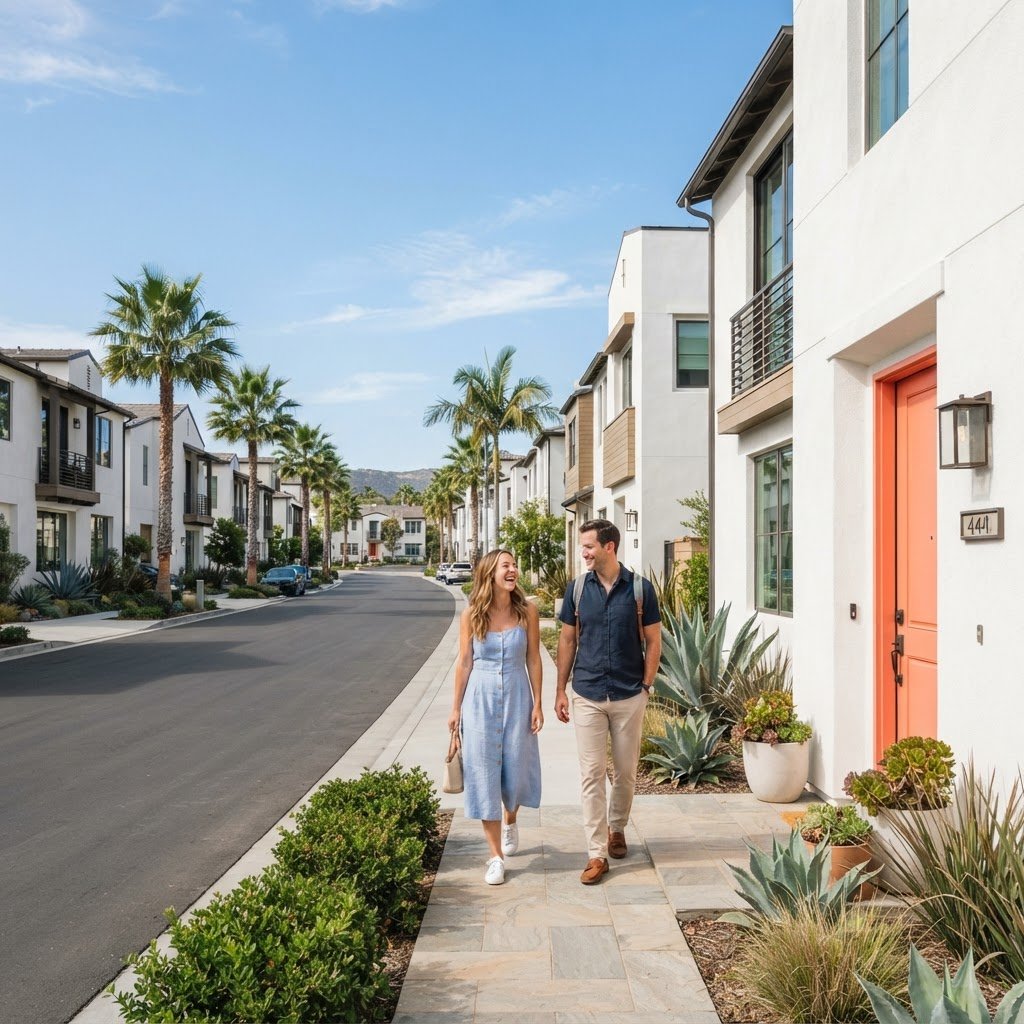
Find new construction homes for sale and budget for the real price
Search by target district and city, but confirm every result at the parcel level before touring. Available new-home inventory in Southern California changes quickly, particularly in areas such as Irvine, Yorba Linda, and Mission Viejo, where available sites can be limited. Do not treat a community name as proof of an attendance zone.
Compare the full cost of each community
Price comparisons should include the base home, lot premium, design selections, homeowners association costs, taxes, financing terms, and closing funds. The California Department of Real Estate notes that buyers commonly need a down payment of 5% to 20% plus closing costs of 3% to 7% of the purchase price, so the displayed base price is not a complete budget.[2]
This table separates the questions families should ask when comparing new construction versus resale homes in a target school area.
Decision factor | New construction | Resale home | What to verify |
|---|---|---|---|
School assignment | May depend on phase or lot | Usually tied to an existing address | District confirmation |
Purchase price | Base price may exclude lot and upgrades | Condition affects value | Complete cash-to-close estimate |
Timing | Release and build schedule apply | Seller timeline applies | Move-in and enrollment dates |
Community amenities | May be delivered over time | Existing amenities are visible | CC&Rs and public report |
The practical tradeoff is certainty: resale can make the existing school path easier to inspect, while a new build requires more written confirmation about a future address and community timeline. For planned developments with shared amenities, California rules address arrangements in which owners fund common areas, including requirements that amenities be accessible to assessed homeowners and maintained through the master association.
Use representation before visiting the sales office
A builder sales office represents the builder, so bring buyer representation into the conversation before your first registration when possible. Research in the SoCal new construction guide can help families understand contracts, timelines, and public reports, while California Civil Code § 2079.14 requires agents to provide a written agency relationship disclosure.[3] Ease represents buyers in new-construction transactions and can negotiate with builders while helping families connect a school-first search to the financial terms of a purchase.
Act early without skipping due diligence
Early releases often provide the widest lot selection, but urgency should not erase verification. Ask for the release calendar, the reservation process, expected construction window, and the deadline for design selections before committing. Track upcoming new-home phase releases in your target districts so you can prepare documents and financing before a desirable phase opens.
Build a ready-to-submit file
Meet with a lender, define a ceiling that includes upgrades and closing funds, and decide which lot traits matter most to your family. A buyer who has already confirmed district priorities can compare a corner lot, a view lot, and a lower-priced interior lot without letting the model-home experience override the school research.
Ask whether a community is part of a master-planned development and which amenities are complete versus planned. Common area amenities subject to certain arrangements must be part of the proposed development and accessible to homeowners charged assessments, which makes the governing documents worth reviewing carefully.[4]
Inspect the actual home before closing
A final walkthrough should focus on the specific home, not the model: test visible systems, document incomplete work, confirm included selections, and match the address to your school-assignment records one final time. Ease can also help buyers evaluate builder incentives, upgrades, and the transaction details that affect cash needed at closing.

Conclusion
Start with target districts, verify the exact lot's elementary, middle, and high school assignments, and preserve those confirmations in writing before signing. Next, watch early releases and compare the full purchase cost rather than the advertised base price alone. Work with a buyer-focused agent before the sales-office visit, especially when lots are scarce and timelines move quickly. For Southern California families prioritizing school certainty alongside a new home, Ease is a practical choice for buyer representation and builder-side negotiations.
Ready to organize a school-first new-build search? Connect with Ease for buyer-focused guidance in Southern California.
Frequently Asked Questions (FAQs)
How do I find new construction in a specific school district?
Finding new construction in a specific school district starts with district boundary maps, then requires confirmation from the enrollment office for each available lot because community marketing and district assignment can differ.
Do school district boundaries affect new construction communities?
School district boundaries affect new construction communities because a development may sit near a boundary, include lots assigned to different schools, or receive revised attendance assignments as new phases and campuses open.
How much more do new homes cost in top rated school districts?
New homes in top rated school districts can cost more because land scarcity, buyer demand, lot premiums, and builder upgrade costs shape pricing, so compare complete purchase estimates instead of relying on a general premium percentage.
Why use a REALTOR for new construction?
Using a REALTOR for new construction gives buyers separate representation from the builder's sales staff, helping them review contract terms, incentives, lot choices, timelines, and questions that affect the final transaction.
What should I look for in a new build walkthrough?
A new build walkthrough should confirm installed selections, visible workmanship, operating fixtures and systems, incomplete items, and the address details that match your written records before closing documents are finalized.
How do I compare new construction communities?
Comparing new construction communities requires reviewing exact school assignments, total purchase costs, lot availability, homeowners association obligations, construction timing, and the written terms governing promised amenities and incentives.
Sources
- California School Dashboard — California Department of Education ↩
- Information for Homebuyers — dre.ca.gov ↩
- California Civil Code Section 2079.14 — california.public.law ↩
- Cal. Code Regs. Tit. 10, § 2792.32 - Alternative Arrangements for Master Planned Communities — LII / Legal Information Institute ↩